Supplements for ADHD and Autism: A Clinical Psychologist’s Evidence-Based Perspective
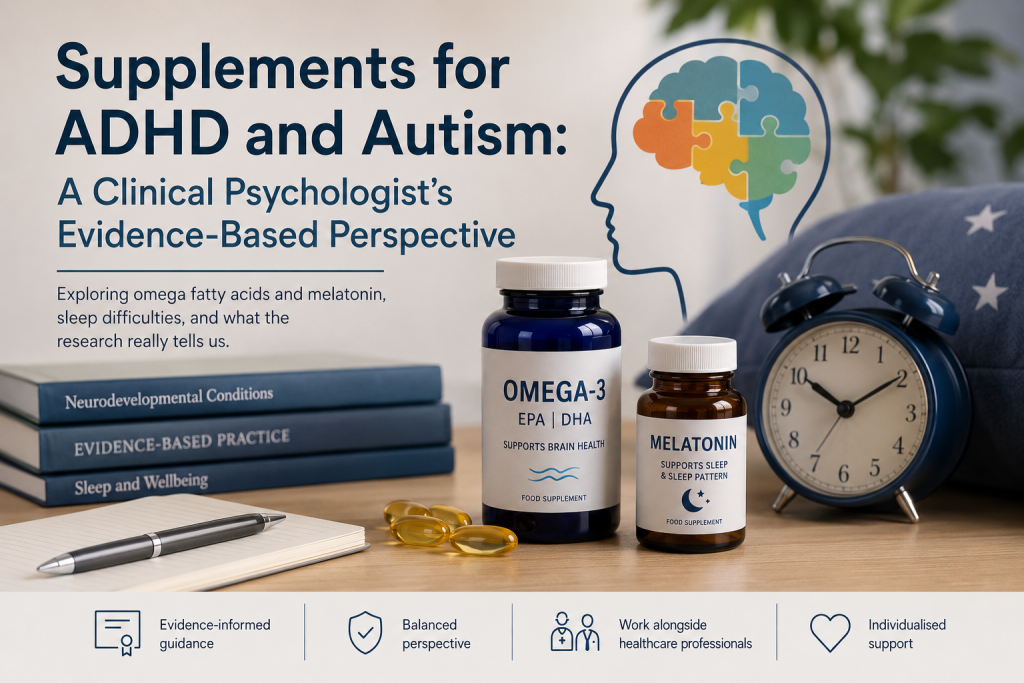
As a Chartered Clinical Psychologist, I undertake neurodevelopmental assessments as part of my clinical practice. During these assessments, I am often asked by individuals and families about supplements and other non-medication approaches for Attention-Deficit/Hyperactivity Disorder (ADHD) and Autism Spectrum Disorder (ASD).
These conversations have become increasingly common, and I felt it would be helpful to bring together some of the available evidence in one place. My intention is to offer a balanced and clinically informed perspective, while also being clear about the limitations of the research and the importance of seeking appropriate medical advice.
There is a great deal of information online about supplements, natural remedies and alternative treatments. Unfortunately, the quality of that information varies considerably. Some sources are helpful, while others make claims that are exaggerated or not supported by reliable research. Supplements may also be presented as treatments or even cures for ADHD or autism, despite the evidence not supporting such claims.
My purpose in writing this article is not to promote supplements or to discourage anyone from considering prescribed medication. I simply want to provide balanced information about two areas that individuals and families frequently ask me about:
- omega-3 and omega-6 fatty acids; and
- melatonin in relation to sleep difficulties.
Omega Fatty Acids
Omega-3 supplements commonly contain eicosapentaenoic acid (EPA) and docosahexaenoic acid (DHA), usually derived from fish oil. Some formulations also include gamma-linolenic acid (GLA), an omega-6 fatty acid often obtained from evening primrose oil.
These fatty acids have important roles in normal brain development, cell-membrane function and a range of biological processes. Because of this, researchers have explored whether supplementation may have an effect on attention, behaviour, mood and emotional regulation.
The research in relation to ADHD is mixed. Some studies have reported small improvements in attention or behaviour, particularly with formulations containing a relatively higher proportion of eicosapentaenoic acid. However, the benefits identified have generally been modest and considerably smaller than those typically associated with established ADHD medication.
Other studies have found no clear improvement in the core symptoms of ADHD. My own interpretation of the evidence is therefore that omega-3 supplementation may offer a small additional benefit for some people, but it is not possible to predict with confidence who will respond.
It is important to be clear that omega fatty-acid supplements are not treatments or cures for ADHD or autism. They should not replace a full neurodevelopmental assessment, psychological or behavioural support, appropriate educational adjustments, or prescribed medication when medication is clinically indicated.
Examples of Omega Fatty-Acid Formulations
Two products that individuals and families have asked me about are:
- Equazen Children’s Liquid – Citrus Flavour
- Equazen Family Triple Strength Capsules
The liquid formulation may be more suitable for younger children or for people who find capsules difficult to swallow. The Family Triple Strength product is a more concentrated formulation intended for older children and adults who can safely swallow capsules.
According to the manufacturer, each Equazen Family Triple Strength capsule contains:
- Eicosapentaenoic acid (EPA): 279 mg
- Docosahexaenoic acid (DHA): 93 mg
- Gamma-linolenic acid (GLA): 30 mg
I have mentioned Equazen because formulations from this product range have been examined in some clinical research and because it is a product that individuals and families often ask me about. This should not, however, be interpreted as a formal endorsement or as evidence that the product has been proven to treat ADHD or autism.
There are likely to be many other products available in the United Kingdom and internationally that contain similar ingredients. However, the concentrations, ratios, purity and overall quality may vary considerably between products. Evidence relating to one particular formulation cannot automatically be applied to every supplement containing omega-3 or omega-6 fatty acids.
Before starting any supplement, particularly for a child or for someone who has an existing medical condition or takes regular medication, I would always advise discussing it with a pharmacist, GP, paediatrician, registered dietitian or another appropriately qualified healthcare professional.
Melatonin and Sleep
Melatonin is a hormone produced naturally by the body. It plays an important role in regulating the sleep-wake cycle, with levels normally increasing during the evening as the body prepares for sleep.
Melatonin does not treat ADHD or autism. Its potential role is specifically related to sleep.
Some individuals with ADHD or autism experience significant difficulties falling asleep, staying asleep or maintaining a consistent sleep routine. When sleep improves, there may also be indirect improvements in daytime concentration, mood, emotional regulation and general wellbeing.
This does not mean that melatonin is treating the underlying neurodevelopmental condition. It simply means that better sleep may make some aspects of daily functioning easier to manage.
Research suggests that melatonin can help some children and young people with neurodevelopmental conditions fall asleep more quickly and may increase their total sleep time. However, it should not automatically be the first response to every sleep difficulty.
Before medication is considered, it is important to look at the wider picture. This may include reviewing sleep routines, sensory needs, anxiety, the sleeping environment, physical discomfort and any other factors that may be contributing to the problem.
In the United Kingdom, melatonin is a prescription-only medicine. It should therefore be accessed through an appropriate medical and pharmacy pathway rather than purchased as an ordinary supplement from a general online retailer.
Different melatonin preparations are available on prescription, including immediate-release and prolonged-release formulations. A prolonged-release preparation releases melatonin gradually and may sometimes be considered when the main difficulty involves staying asleep or waking repeatedly during the night. An immediate-release preparation may sometimes be more relevant when the main problem is falling asleep.
This distinction is not always straightforward, and the most suitable formulation, dose and timing will depend on the individual. These decisions should be made following an appropriate medical assessment.
It is also important not to assume that a melatonin product sold online is equivalent to a medicine prescribed in the United Kingdom. Products may differ in their strength, release profile, inactive ingredients, manufacturing standards, consistency of dose and regulatory oversight.
For these reasons, I would always recommend discussing any supplement with a qualified healthcare professional before making a purchase. They can advise whether it is appropriate for the individual, consider any existing medical conditions or prescribed medication, and help ensure that the product chosen is both safe and suitable for their specific circumstances.
Understanding Sleep Difficulties More Fully
Sleep problems can have many different causes, and the most effective support will depend on understanding what is contributing to them.
Possible factors may include:
- inconsistent bedtime routines;
- anxiety or emotional distress;
- sensory sensitivities;
- medication effects;
- pain or physical discomfort;
- breathing difficulties;
- environmental factors;
- restless legs or unusual movements during sleep; and
- an underlying sleep disorder.
Melatonin should therefore not be viewed as the first or only answer. Where it is clinically appropriate, it may form one part of a wider sleep plan that also considers routines, the environment, emotional wellbeing and any underlying medical concerns.
Keeping Expectations Realistic
I fully understand why some people may feel more comfortable with something described as natural. However, natural does not necessarily mean effective, risk-free or suitable for everyone.
Supplements can cause side effects, interact with prescribed medication or affect an existing health condition. Products may also differ in quality and may not always contain exactly what a person expects. There is also a risk that relying too heavily on supplements could delay access to interventions with a stronger evidence base.
For the core symptoms of ADHD, prescribed medication continues to have substantially stronger research support than omega fatty-acid supplementation.
This does not mean that supplements have no place at all. Omega-3 products may offer a modest additional benefit for some individuals, particularly as one part of a broader support plan. Similarly, melatonin may be helpful for certain sleep difficulties when it has been appropriately assessed and prescribed.
Neither should be presented as a cure for ADHD or autism.
In practice, the most helpful approach is often an individualised one. Depending on the person’s needs, this may include:
- a comprehensive neurodevelopmental assessment;
- psychological or behavioural support;
- suitable educational or workplace adjustments;
- help with sleep and daily routines;
- physical activity and nutritional advice;
- consideration of prescribed medication;
- support for parents and carers; and
- carefully selected supplements where clinically appropriate.
I do not believe the discussion needs to be reduced to a choice between what is “medical” and what is “natural”. A more useful question is:
What combination of safe, proportionate and evidence-informed support is right for this individual?
My Professional Role
As a Chartered Clinical Psychologist, I can discuss the broader evidence relating to attention, emotional regulation, sleep and neurodevelopmental functioning. I can also help individuals and families think more clearly about their concerns and identify the questions they may wish to raise with their healthcare professionals.
However, decisions regarding supplement doses, possible medication interactions, medical suitability and prescribing should be made with a pharmacist, GP, paediatrician, psychiatrist, registered dietitian or another appropriately qualified healthcare professional.
Where appropriate, I may recommend that an individual seeks further advice from an experienced medical professional.
Important Safety Information
This article is intended to provide general information. It is not a prescription, an individual treatment recommendation or a substitute for assessment by an appropriately qualified healthcare professional.
Professional advice is particularly important when:
- a supplement is being considered for a child or young person;
- the person is pregnant or breastfeeding;
- there is a fish or seafood allergy;
- there is a bleeding disorder;
- anticoagulant or antiplatelet medication is being taken;
- there are existing physical or mental health conditions;
- other medication or supplements are already being used; or
- surgery or another medical procedure is planned.
Transparency Statement
I do not receive commission, sponsorship or financial incentives from any manufacturer or product mentioned in this article. Any products referred to are included solely as examples to help explain the available evidence and should not be interpreted as personal endorsements.
My intention is not to tell individuals or families what they should choose. My aim is to help people move away from confusing or exaggerated claims and towards decisions that are informed, realistic and safe.
Dr Nistor Becia MBE
Chartered Clinical Psychologist